

Looking for an electrician in Makkah? You need someone who comes to your district, knows where to look before taking anything apart, tells you the price before starting, and does not leave until the job has been tested in front of you. That is the work we do in Makkah homes every day: sudden faults, hidden short circuits inside walls, burnt sockets and switches, distribution board upgrades and earth-leakage protection, first-fix wiring for new flats and villas, chandeliers, spotlights and ceiling fans, and dedicated circuits for air conditioners and water heaters. Call or WhatsApp 0565564857.
We work in flats, villas, duplexes, rest houses, furnished apartments, small shops and offices across every district of Makkah, from the neighbourhoods near the Haram to the new plans on the edge of the city. We take calls 24 hours a day, send a technician the same day wherever possible, and tell you the real arrival time rather than a promise nobody can keep.
The service at a glance
- We fix: partial or total outages, breakers that keep tripping, burning smells, damaged sockets and switches, shorts inside walls
- We install: boards, breakers and RCDs, chandeliers, spotlights and hidden LED, ceiling fans, water heaters, AC circuits, cameras and intercoms
- We wire: first-fix and second-fix for flats, villas and annexes, and rewiring of older homes with minimal breaking
- How it works: photo or video on WhatsApp, a visit with proper test equipment, then a price agreed before any work
- Payment: after the job is finished and tested in front of you, with a workmanship guarantee
- Coverage: every district of Makkah, on 0565564857 by call and WhatsApp
How to book a home electrician in Makkah
Most people who call us have just lost the lights, or noticed a strange smell from a socket in the living room. Nobody in that moment wants a long conversation. So we keep booking short, and every step has a reason: the technician should arrive with the right part, and you should know the price before you commit to anything.
- Call or WhatsApp 0565564857 with your district and the type of property: flat, villa, duplex, rest house or shop.
- Send a photo or short video of the fault, or of the board with its cover closed. Ten seconds of video saves ten minutes of explaining.
- We agree a time and tell you when the technician will actually get there. Urgent faults get a same-day visit whenever a nearby electrician is free.
- The technician arrives with test equipment: multimeter, clamp meter, insulation tester, and a thermal camera when a hidden short needs finding.
- He diagnoses and explains the problem in plain words, then agrees the price with you before touching anything.
- The repair is done with genuine parts, or with parts you bought yourself if they are suitable and sound.
- Everything is tested in front of you: breakers reset, loads switched on, the RCD test button pressed, and connections checked for heat.
- You pay once the work is done and tested, and the work carries a workmanship guarantee; ask the technician about its period for your job.
What to send on WhatsApp so the electrician arrives prepared
A good message cuts the visit in half. This is what helps most:
- Two lines about the fault: when it started, whether it affects one room or the whole home, and whether it happened after switching on a particular appliance.
- A photo of the board with the inner cover in place and no wires touched, so we can see the breaker type and whether there is an RCD.
- For installations: a photo of the fitting and where it goes, the rough ceiling height, and whether the ceiling is gypsum or concrete.
Example message: “Hi, I’m in Al-Naseem, second-floor flat. Power is off in the kitchen and bathroom only, and the breaker trips again every time I push it up. Here’s a photo of the board.” From a message like that, the technician will usually suspect the RCD or damp in the bathroom circuit, and comes ready for both.
Got a fault right now?
Send us a photo of the board or the socket with your district, and we will reply with the next step and the technician’s arrival time.
Call 0565564857WhatsApp 0565564857Home electrician services in Makkah: the full list
We have grouped the services the way problems actually show up at home, so you can find yours quickly. Every group follows the same method: diagnose first, agree the price, then do the work and test it.
Faults and emergencies
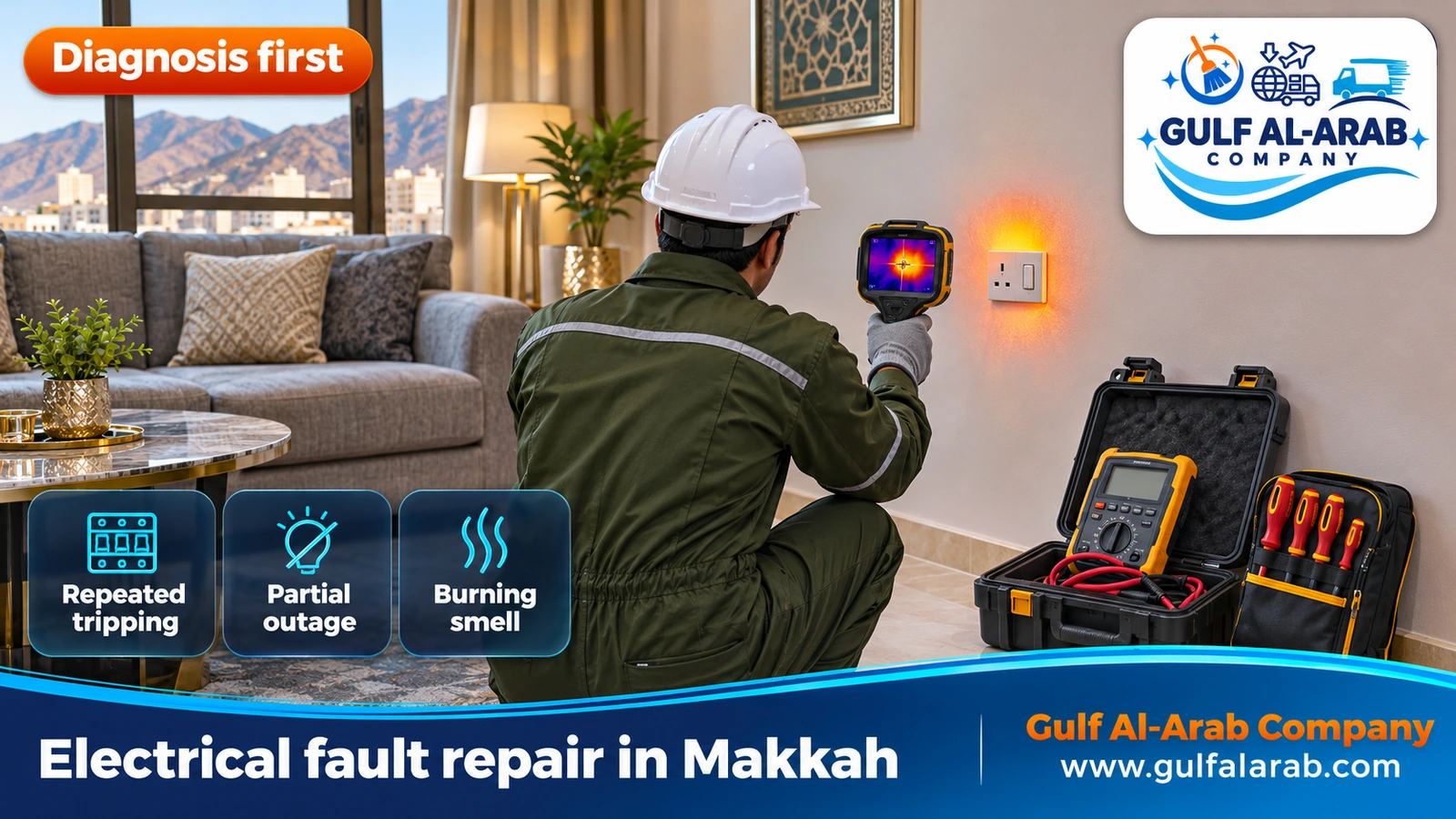
This is what people most often need an electrician in Mecca for: half the house dark, a breaker that will not stay up, a blackened socket, a crackling noise inside a wall. The technician does not start by guessing. He isolates the circuits one by one until he reaches the faulty one, then measures insulation and current to tell whether the problem is a cable, an appliance or a breaker.
- Locating and repairing short circuits, including hidden ones inside walls and gypsum ceilings.
- Partial outages in one room or floor, and total outages when the cause is inside the property.
- Breakers that keep tripping: we find out whether it is overload, a short, earth leakage or a weak breaker.
- Meter-side and low-voltage checks to tell whether the problem is inside the home or on the network.
One thing worth knowing: if the fault is in the meter itself or in the supply cable from the network, that is the Saudi Electricity Company’s job, and you contact them through their customer service. Our part is to measure and confirm where the fault really sits, so you do not wait days for the utility over a breaker inside your own home, or pay an electrician for something the utility has to fix.
Distribution boards, breakers and protection
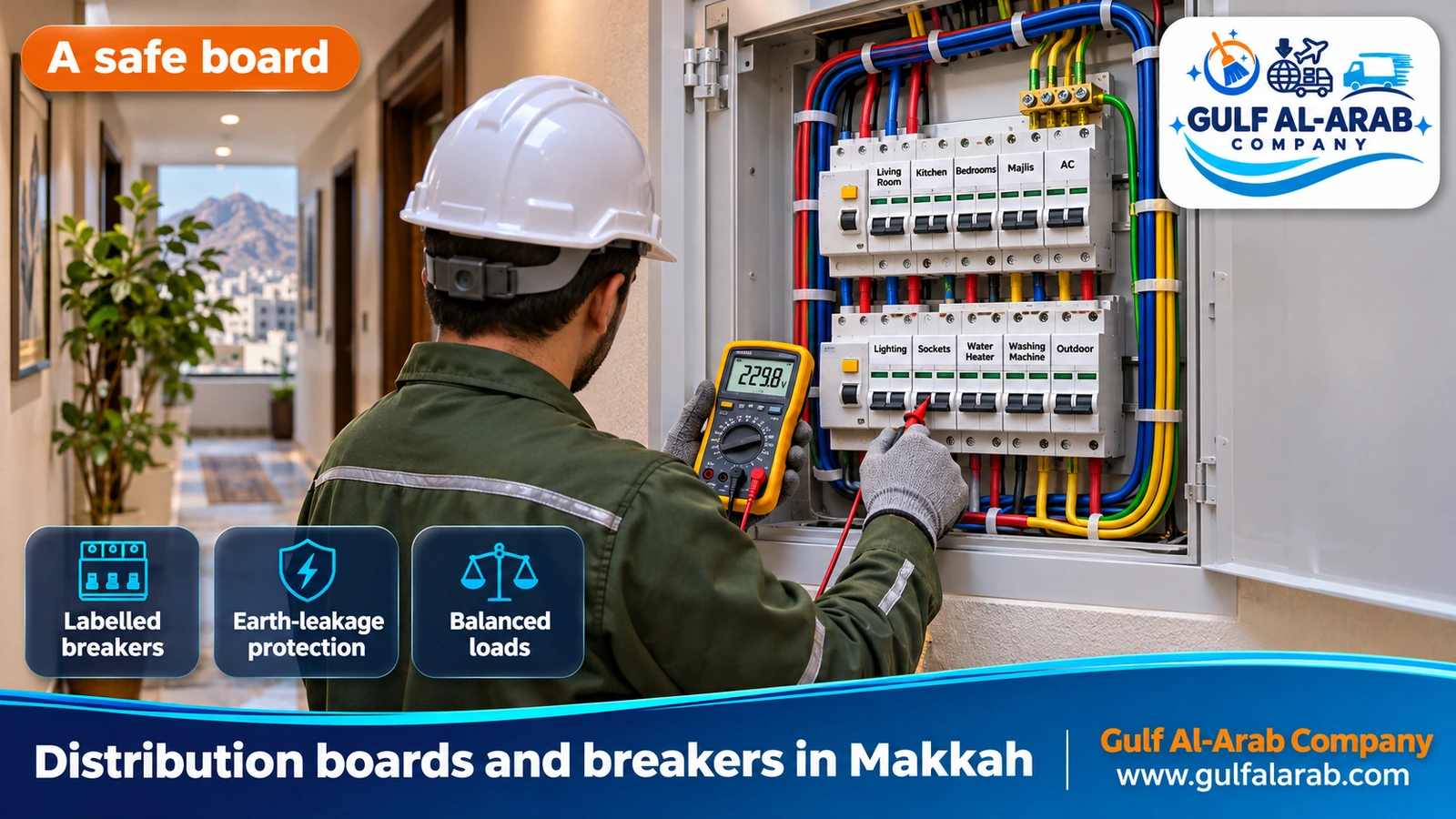
The distribution board is the heart of a home’s electrics, and most recurring faults either start there or show up there. In older houses we often find small boards that cannot handle today’s loads, breakers with no labels so nobody knows which one is the kitchen and which is the AC, and sometimes no earth-leakage protection at all.
New distribution board
A board sized for all the home’s circuits with spare ways for later, wired neatly and tied in.
Breaker replacement
Swapping weak or damaged breakers for ones rated to match the cable size and circuit load.
RCD protection
Earth-leakage devices for bathrooms, kitchens and outdoor circuits to protect people, not just cables.
Load balancing
Moving heavy loads between circuits and phases so one circuit is not carrying everything.
Wiring, first-fix and rewiring
Wiring in a new flat, villa or annex is the work you live with for years, and any mistake only shows once the walls are closed and painted. That is why first-fix has its own section further down. In short, this group covers:
- Complete first-fix for flats, villas, duplexes, annexes and rest houses: conduits, boxes, cables, and a dedicated line for every heavy load.
- Second-fix: sockets, switches, light fittings and the board, with every circuit tested.
- Adding new points in an occupied home: an extra kitchen socket, a TV outlet, a light in the courtyard.
- Rewiring older homes with as little breaking as possible, reusing existing conduits where they allow.
- Separating each floor’s circuits in multi-storey homes, and feeding the annex or roof from its own circuit.
- Converting older circuits and appliances from 127 V (what people call “110”) to 220 V when needed, after checking that cables and fittings are fit for it.
Lighting and chandeliers
Lighting changes how a home looks for less money than almost anything else, and it is also where we see the most poor work: a heavy chandelier hanging from gypsum alone, spotlights crammed together and cooking the ceiling, hidden LED on a cheap driver that dies within months.
- Chandelier installation of every size, including heavy crystal pieces that must be fixed into the concrete slab.
- Spotlights laid out at proper spacing, and replacement of failed units.
- Hidden cove lighting in gypsum ceilings, LED strips and aluminium profile lighting.
- Facade, courtyard, garden and boundary-wall lighting, including facades on hillside homes.
- Temporary lighting for weddings and Eid, connected safely and removed afterwards.
Appliances, air conditioners and water heaters
Any appliance that draws a heavy current needs its own circuit. Plenty of homes break that rule and pay for it every summer. Our work here is the electrical side only: the line, the breaker, the outlet and a safe connection.
- A dedicated line and breaker for each window or split AC unit. We do not handle refrigerant or gas; that is the AC technician’s job.
- Water heater connection with a nearby isolator, plus thermostat and element checks when the water stays cold or the breaker trips.
- Kitchen circuits: electric oven, hob, cooker hood, under-cabinet lights, and enough sockets above the worktop.
- Ceiling fan installation, bathroom and kitchen extractors, and repair of fans that wobble or lose speeds.

Pumps, tanks and outdoor power
Many Makkah homes rely on a ground tank, a roof tank and a pump between them. When the pump or the float switch fails, an electrical fault quickly becomes a house with no water.
- Water pump wiring and breakers, and repair of pumps that never switch off.
- Electric float switches that start and stop the pump automatically, and remote pump switches.
- Well pump electrics for rest houses and small farms, with dry-run and overload protection.
- Pump control panels and shared stair and entrance lighting in apartment buildings.
Security and smart home
This is where electrics meet peace of mind: a camera that shows who is at the door, a doorbell that works, lights that come on by themselves at sunset.
- CCTV installation with concealed cabling and the recorder connected.
- Audio and video intercoms, and doorbells.
- TV wall mounting with cables hidden in the wall or in a neat trunking, and the receiver connected.
- Smart switches, lighting controlled from your phone, timers and motion sensors.

Special jobs: EV chargers, generators, shops and occasions
EV home charger
A dedicated line from the board with the right breaker and RCD for a wall charger in the garage or courtyard, after checking the board’s capacity.
Generator changeover
A manual or automatic changeover switch so the generator and the grid can never be connected together, for rest houses and homes that need backup.
Shops and signs
Power for small shops and offices, and illuminated facade signs on their own breaker and timer.
Occasion lighting
Safe temporary connections for weddings and Eid, with breakers and weather protection, removed afterwards without a trace.
Earthing and surge protection
Installing or testing earthing and measuring its resistance, plus surge protection for sensitive electronics.
Common electrical faults in Makkah homes: symptom, cause, fix
After enough time inside other people’s homes, faults become familiar: the same symptoms come back with a limited set of causes. The table below gathers what we see most in Makkah flats and villas. Treat it as a guide to understanding, not a replacement for testing, since one symptom can have more than one cause.
| Symptom | Likely cause | What the electrician does |
|---|---|---|
| Breaker trips the moment you reset it | A direct short in the circuit, or a faulty appliance plugged into it | Unplugs loads, tests insulation branch by branch, finds the cable or appliance and repairs it |
| Breaker trips minutes after the AC starts | Overload, an undersized breaker or a thin cable | Measures current with a clamp meter and proposes a dedicated line or a correctly rated breaker |
| RCD trips when the water heater switches on | Leakage from the heating element or damaged insulation | Tests the heater’s insulation and replaces the element, or advises a new heater if it is corroded |
| Socket blackened or melted | Loose contact or a load above the socket’s rating | Replaces the socket and the burnt cable behind it, and moves the load to another outlet |
| Lights dim across the house under load | Low voltage, or a loose main or neutral connection | Measures voltage at the board and the meter to see if the cause is inside or on the network |
| A warm patch or discoloured paint on a wall | A hidden joint overheating inside the wall | Locates it with a thermal camera and opens only a small hole to fix it |
The most common cause behind these faults is not age alone; it is rushed work. A cable thinner than the circuit needs, joints wrapped in tape instead of proper connectors, a breaker rated above the cable “so it doesn’t trip”, cheap sockets that cannot take the load. Finding the real cause is what makes a repair last.
Short-circuit detection without tearing the house apart
Hidden shorts wear people out: the breaker trips, nothing is visible, and the last technician suggested “let’s break the wall and see”. The right way is the opposite. We start by measuring and narrowing down, and only open a wall at the point where the fault is proven.
Multimeter
Measures voltage, continuity and resistance at each point. The first tool out for any fault.
Clamp meter
Reads the current in a cable without disconnecting it, so we know if a circuit is overloaded.
Insulation tester
Applies a test voltage and measures insulation resistance, catching damaged cable inside a wall before it burns.
Thermal camera
Sees heat behind paint and gypsum, revealing a joint that is overheating or a breaker working beyond its limit.
Cable tracer
Follows a cable’s route through the wall so we know where it runs before drilling or fixing anything.
Earth tester
Measures the resistance of the earth electrode, showing whether the earthing actually protects the house.
In practice, the technician brings circuits back one at a time, splits the faulty one at its junction boxes and insulation-tests each branch until the damaged section is found. The thermal camera or tracer then pins down the spot, so the opening is usually the size of a hand, patched afterwards.
Why does the breaker trip? MCB vs RCD explained
“My breaker keeps tripping, what do I do?” is the question we get most on WhatsApp. The answer starts with which type of breaker tripped, because each one trips for a different reason.
The ordinary breaker (MCB)
A miniature circuit breaker protects the cable from two things: overload and short circuit. If a circuit draws more current than its rating for a while, an element inside heats up and trips it after seconds or minutes; that is what happens when the AC, heater and iron all share one socket. If two conductors touch, a huge current flows instantly and it trips straight away. The rule is that a breaker is chosen for the cable, not for the appliance, so fitting a bigger breaker “so it stops tripping” just leaves the cable to overheat inside the wall unprotected.
The earth-leakage breaker (RCD)
An RCD protects people rather than cables. It compares the current going into a circuit with the current coming back; if there is even a small difference, meaning some current is escaping to earth through a person or through damp, it trips in a fraction of a second. The usual sensitivity for protecting people in homes is 30 mA, and it is essential for bathrooms, kitchens, roofs, courtyards and anywhere with water. It has a small test button: press it every month or two. If it does not trip, it is not protecting you.
| MCB | RCD | |
|---|---|---|
| Protects | The cable and circuit from overheating and fire | People from electric shock, and the home from leakage fires |
| Trips on | Overload or short circuit | Current leaking to earth, even a small amount |
| Repeated tripping usually means | Too many appliances on one circuit, damaged cable, weak breaker | Damp, a leaking appliance such as a heater or washer, a neutral fault |
| What you can do | Unplug some loads and reset it once | Unplug appliances in wet areas and reset it once |
| When to call us | If it trips again without heavy loads | If it trips again, or the test button does nothing |
Do not keep resetting it: A breaker that trips, gets reset and trips again is telling you something. Every reset pushes a heavy current through a damaged cable, and that is how a small short becomes a fire inside the wall. Reset it once after unplugging appliances; if it trips again, leave it down and call.
Burning smell or smoke from a socket? Do this now
Burning plastic sometimes smells oddly like fish, and many people do not notice it until it gets strong. If you smell burning and cannot find the source, or you see smoke or sparks from a socket, switch or the board, the right order is:
In this order:
- Switch off the main breaker straight away if you can reach it safely. Do not rely on a room breaker unless you are sure.
- Never pour water on an electrical fire or a smoking socket. Water conducts electricity.
- If a small flame remains after the power is off, use a powder or CO2 extinguisher if you have one, or smother it with a dry blanket.
- If the flame grows or the room fills with smoke, get everyone out and call Civil Defence on 998.
- Do not touch or unscrew the burnt socket or cable, and do not restore power until a technician has checked it.
- Take a photo and send it on WhatsApp; we will tell you whether the rest of the home can run safely with only the damaged circuit isolated.
Emergency electrician in Makkah: what counts as urgent?
Not every outage is an emergency, and some quiet faults are more dangerous than a blackout. Treat it as urgent if you see smoke or sparks, smell persistent burning, hear crackling from a wall or the board, feel a shock from an appliance or tap, or lose power to the fridge, medical equipment, or a home with an elderly or sick person in the middle of the heat. We take urgent calls 24 hours a day, send the nearest free technician, and tell you honestly when he will arrive.
Breaker tripping or a burning smell?
Switch off the main breaker first, then call or send a photo of your board, and we will arrange the nearest electrician in Makkah.
Call 0565564857WhatsApp 0565564857First-fix wiring for new flats and villas in Makkah
First-fix decides how you will live in the house for years: whether you can charge your phone beside the bed, whether the kitchen can take your appliances, whether the breaker drops every time two ACs run together. Whatever is forgotten at this stage costs several times more after finishing. We follow the general electrical requirements of the Saudi Building Code: cables sized for their loads, earthing, leakage protection in wet areas, and separated circuits.
Stages of first-fix and second-fix
- Planning session on the drawings or on site: furniture layout, beds, TV, AC units, heaters and kitchen appliances.
- Load calculation and circuit split: lighting, general sockets, kitchen, one circuit per AC, one per bathroom heater, laundry.
- Conduits and boxes installed before plastering, in straight runs at consistent heights, firmly fixed.
- Cable pulling with consistent colours and correct sizes for each circuit, leaving enough length in the boxes.
- Second-fix after painting: sockets, switches, fittings, the board, and breaker labels.
- Testing and handover: insulation and earth readings, RCD test, and every point switched on in front of you.
What to confirm before the walls are closed
- A dedicated line and breaker for every AC unit and every water heater, plus one for an electric oven.
- RCD protection for bathrooms, kitchen and outdoor circuits.
- A spare empty conduit from the board to the roof or courtyard for later additions such as an EV charger.
- Separate conduits for camera, internet and intercom cables, kept away from power cables.
- A board with more ways than you need today.
- Consistent switch and socket heights, and at least two sockets beside every bed.

Planning points room by room
These are rough figures for an average family home, adjusted to each room’s size and use. The goal is that no room ever needs a permanent extension lead.
| Room | Sockets | Lighting | Dedicated lines |
|---|---|---|---|
| Master bedroom | 6 to 8, two beside each side of the bed | Ceiling light + spots or cove light + bedside switch | AC, TV point |
| Living room or majlis | 8 to 12 around the walls | Chandelier + spots + cove light on separate switches | One or more ACs, TV and internet |
| Kitchen | 6 to 10 above the worktop | Ceiling light + under-cabinet light | Oven, hob, hood, fridge, dishwasher |
| Bathroom | One socket away from water, on an RCD | Ceiling light + mirror light | Water heater, extractor |
| Courtyard and roof | Weatherproof outdoor sockets | Wall and facade lights on a sensor or timer | Pump, future EV charger |
Villas and duplexes get a sub-board per floor, so one floor can be isolated for maintenance. Annexes and rest houses get a dedicated feed sized for the distance, since a long thin cable causes voltage drop that the AC feels first. First-fix is quoted after a site visit.
Signs an older home needs rewiring
Many houses in Makkah’s older districts were built before every room had an AC and every hand had a phone to charge. The cables may still be fine, or they may be worn out after years of heat. These signs say it is time:
- Cloth or rubber insulation that is cracked, or plastic that has gone brittle and snaps when touched.
- A board with old fuses, or unlabelled breakers and no RCD.
- Two-pin sockets with no earth, or switches that get warm when the lights are on.
- Repeated blackening around sockets, or a faint smell when certain appliances run.
- Breakers that trip whenever two appliances run together under normal loads.
- Circuits still running at 127 V that need converting.
- Surface wiring added piece by piece over the years.
Rewiring does not mean knocking walls down. Where the old conduits are sound, we pull new cable through them and replace the board, sockets and switches; where they are blocked, we use neat skirting trunking or a narrow chase that is patched and painted. The riskiest circuits, kitchen, bathrooms and ACs, come first.
Chandeliers, spotlights and lighting tips that change a room
Good lighting is not more bulbs; it is the right light in the right place. We often hear “we put spots everywhere and now the living room looks like a clinic”, or “the chandelier is beautiful but the room feels dark”. Usually the lighting was designed as one layer instead of several.
How much light does each room need?
Light reaching a surface is measured in lux. You do not need a meter, but rough figures help when choosing how many fittings and how strong:
| Space | Approximate light level | Suggested colour |
|---|---|---|
| Living room and majlis | 150 to 300 lux, with a brighter layer when needed | Warm 3000 K, or neutral 4000 K for reading |
| Bedrooms | 100 to 200 lux | Warm 2700 to 3000 K |
| Kitchen worktop | 300 to 500 lux | Neutral 4000 K |
| Study or home office | 300 to 500 lux on the desk | Neutral 4000 K |
| Bathroom and mirror | 150 to 300 lux, with side light at the mirror | Neutral 4000 K |
| Courtyard and facade | Depends on use; even spread without glare matters most | Warm for the facade, neutral for parking |
Warm or cool?
Warm, yellowish light is easy on the eyes in the evening and suits majlis rooms and bedrooms. Neutral white shows colours as they are and suits kitchens, bathrooms and offices. Very cool white, 6000 K and above, tends to make a home feel cold, and many people regret it in living rooms. Mixing colour temperatures in one ceiling looks untidy, so pick one per room.
Heavy chandeliers, spots and hidden lighting
- A heavy chandelier never hangs from gypsum alone. We fix a hook or plate into the concrete slab above the false ceiling and make sure it carries the weight safely. Large crystal pieces need assembly that can take hours, and very large ones can take days, with scaffolding or a lift.
- Height: where people walk, the bottom stays comfortably above head height; over a dining table it comes lower, close to the table without blocking the view across it.
- Spotlights are spaced evenly, roughly a metre to a metre and a half apart, and set back from the wall enough to avoid harsh hot spots on the paint.
- Hidden LED needs a good driver placed where it can be reached for maintenance, not buried in gypsum with no access hatch.

Makkah summers and AC circuits: why the power trips in the heat
Our AC work is electrical only: line, breaker, outlet and connection; refrigerant and the cooling cycle belong to the AC technician. Makkah’s summer heat keeps air conditioners running for hours without a break, often in every room at once. That is when the weak points hidden all winter show up: a thin AC cable, one breaker shared by two units, a board never designed for that load. A compressor also draws more current as it starts than while running, so several units starting together on one circuit will trip it.
One line per AC
Each split or window unit gets its own line from the board and a breaker rated for its capacity and cable size.
Correct cable size
Cable is chosen by the unit’s capacity and the distance from the board; longer runs need a larger size.
Pre-summer check
Measuring each unit’s current and the temperature of its connections before the peak heat prevents midnight breakdowns.
Spread across phases
On three-phase supplies we spread the AC units across all three phases so no single phase carries the bulk.
Electrical maintenance that lowers your bill
A high summer bill is not entirely unavoidable. Part of it is real consumption, part is waste you can stop with simple steps, some you can do yourself and some that need a technician once:
- Set the AC to around 24 degrees instead of 18; the comfort difference is small and the consumption difference is large.
- Clean AC filters regularly; a clogged filter makes the unit run longer.
- Switch old bulbs to LED, which use a fraction of the power and put less heat into the room.
- Put the water heater on a timer so it does not run all day; in summer a low thermostat setting is enough.
- Switch off appliances left on standby overnight, or put them on a switched power strip.
Keeping children safe around electricity
A two-year-old finds every socket at eye level and pushes whatever is in hand into it. Most electrical accidents with children can be prevented with small changes, and we recommend them in every home with little ones:
- Safety covers on unused sockets, or shuttered sockets that block an object pushed into one hole.
- An RCD covering the whole home, or at least the sockets, bathrooms and kitchen.
- Sockets in children’s rooms set higher at first-fix and kept away from the bed.
- No cheap power strips or long leads on the floor where children play.
Safety inspection, earthing and surge protection
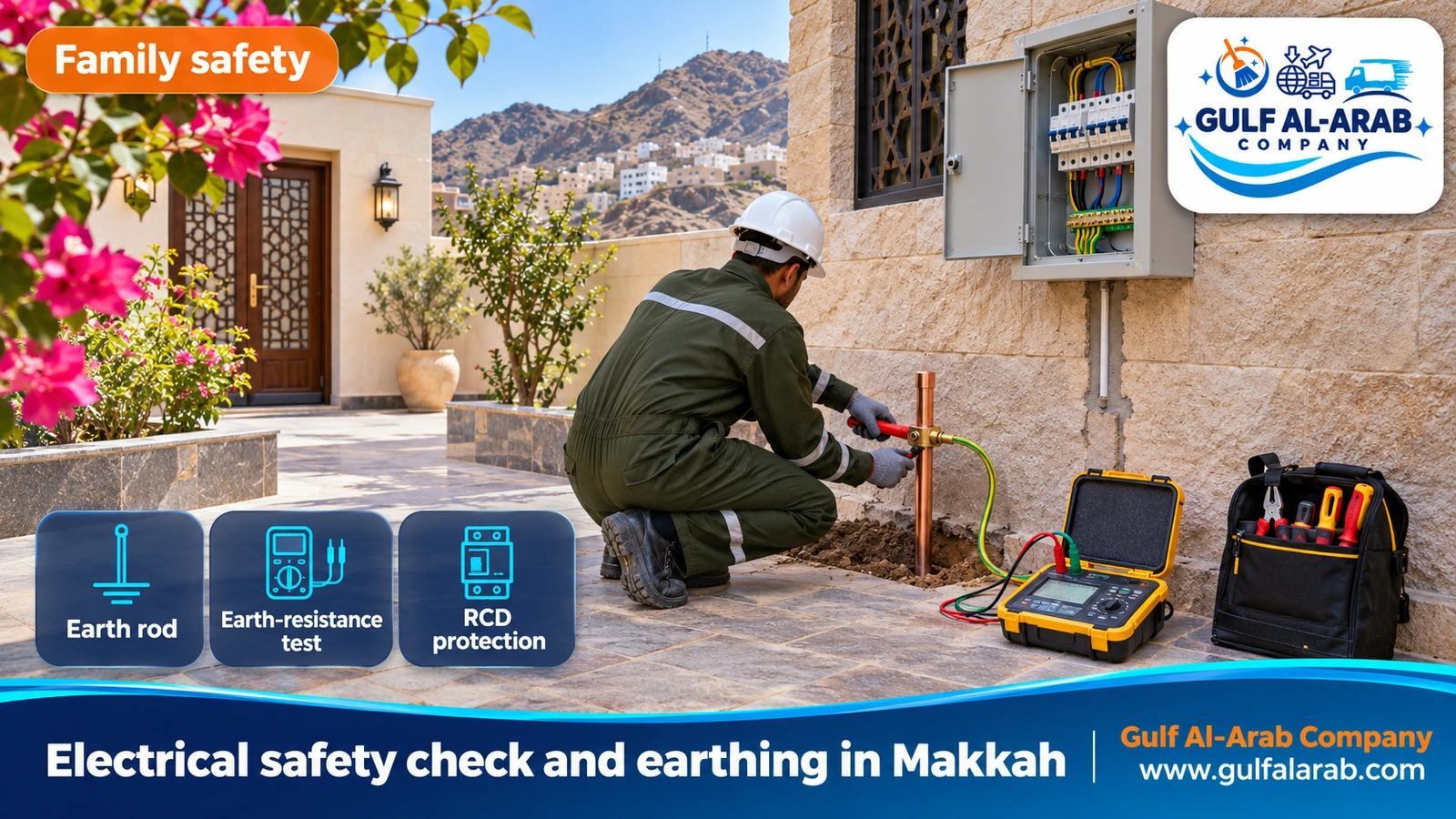
Earthing gives leaking current a path to the ground instead of through your body when a metal appliance develops a fault. In many homes we find an earth wire at the sockets that is not connected to a real earth electrode, or an electrode with resistance too high to do its job. The check is made by measuring earth resistance, not by looking.
- Measuring earth electrode resistance, and adding or improving an electrode when needed.
- Making sure earth reaches every socket and metal appliance such as heaters and washing machines.
- Surge protection at the board for sensitive appliances and electronics.
- For exposed or hillside homes and rest houses, we explain suitable lightning protection options.
Check your home’s electrics before summer
One inspection visit finds overheating joints, weak breakers and broken earthing before they turn into a breakdown.
Call 0565564857WhatsApp 0565564857How to choose the best electrician in Makkah
Whether people search for the “best electrician” or a “master electrician in Makkah”, they want one thing: someone who fixes it right the first time and does not leave them with a new problem. Here is a short checklist, whether you choose us or someone else:
- He arrives with test equipment, not just a screwdriver and tape.
- He explains the cause in words you understand and offers options when there is more than one fix.
- He agrees the price before starting and does not add items afterwards.
- He uses parts from known sources, and accepts parts you buy yourself if they are suitable.
- He never fits a breaker larger than the cable, and never removes an RCD because it “trips too much”.
- He gives a workmanship guarantee and answers if the fault returns.
How much does a home electrician in Makkah cost?
We do not publish fixed figures, because electrical jobs vary enormously from one home to the next, even when they carry the same name. “Installing a large chandelier” can mean half an hour for a medium fitting under a low ceiling, or a lift and three days of assembly for a huge crystal piece in a double-height majlis. Replacing one socket is not the same as finding two metres of burnt cable behind it. So the price is set once the electrician sees the job, or a photo or video of it on WhatsApp, and agreed with you before work starts.
| Job | What sets the price |
|---|---|
| Fault inspection and diagnosis | Type of fault, number of circuits to test, and whether a thermal camera or insulation test is needed |
| Socket or switch replacement | Number of points, type of fitting, and the condition of the cable behind it |
| Spotlight installation | Number of units, ceiling type, and whether existing wiring is there or new wiring is needed |
| Chandelier installation | Size and weight, ceiling height, assembly time, and whether it needs a concrete fixing or a lift |
| Ceiling fan installation | Fan type, whether a ready point exists, and the fixing method |
| Water heater connection | Whether a line and isolator exist, heater location, and cable condition |
| AC line with dedicated breaker | Distance from the board, cable size, and surface or concealed routing |
| Breaker replacement | Breaker type and rating, board condition, and who supplies the part |
| New distribution board | Number of circuits, breaker types, RCD, and rearranging connections |
| CCTV cameras | Number of cameras, cable lengths, how they are concealed, and the recorder type |
| EV charger circuit | Charger power, distance from the board, and current board capacity |
| First-fix for a flat or villa | Area, number of points and circuits, fittings chosen; quoted after a site visit |
Send a photo of the job on WhatsApp 0565564857 and we will give you the price before the visit whenever the photo is enough.
What pushes the price up or down?
- Access: high ceilings, upper floors with no lift, tight spaces behind appliances.
- Parts: who supplies them, what type, and whether they are available locally.
- Existing wiring: a ready conduit versus a new run.
- Job size: several jobs in one visit cost less than separate visits for each.
- What the work uncovers: if a deeper cause appears, we stop and tell you before adding anything.
Furnished flats and buildings: maintenance before the busy seasons
In Makkah, electrical loads in apartment buildings and furnished flats swing between quiet months and months when everything is full. A unit closed for months opens, its ACs and heaters switch on together, and hidden problems appear: a weak breaker, a corroded heater element, a damp socket.
So for building owners and furnished-flat managers we suggest an organised check before each season:
- A walk through every unit: board, breakers, RCD, sockets, lighting, heaters and AC lines.
- A thermal scan of the main board and floor boards to catch overheating connections.
- Checks on stair, entrance and parking lighting, pump control panels and outdoor lighting.
- A list of repairs per unit, with priority and price agreed before work.
- Repairs scheduled to disturb residents as little as possible, and breakers labelled in every unit.
Electrician near me in Makkah: the districts we cover
Looking for the nearest electrician to your location? Just send your district name and we will send the closest technician. We serve every district of Makkah, and each of the districts below has its own page about its homes and the faults we see most there:
We also reach many districts and plans not listed here, such as Al-Otaibiyah, Al-Adl, Al-Taysir, Al-Zaidi, Al-Buhairat and Al-Jiranah. Send your location on WhatsApp and we will tell you when the technician can be with you.
Why people call us when they need an electrician in Mecca
At Gulf Al-Arab Company we know that the person calling is not looking for a company name; they want someone to fix a problem at home now. So the service is built on simple things you notice from the first call:
Diagnosis with instruments
We measure before we dismantle, and locate the fault before opening any wall.
Price before work
You know the amount before the technician starts, with nothing added without your approval.
Pay after testing
You pay after the job is finished and tested in front of you, not before.
Workmanship guarantee
A guarantee on the work done; ask the technician about its period for your job.
We also know that the electrician’s number you save in your phone has to answer when you need it. We take your calls and messages 24 hours a day, and we tell you straight if the technician is running late.
A home electrician in Makkah, one message away
Call or send a photo of the fault and your district to 0565564857, and we will reply with the price and arrival time.
Call 0565564857WhatsApp 0565564857